
If you're comparing Moz, Ahrefs, and Semrush right now, you're probably close to pulling out your credit card. So let's skip the filler and give you what you actually need.
In this head-to-head comparison, we break down exactly how Moz, Ahrefs, and Semrush stack up on features, data, and price so you can pick the right SEO tool in 2026. We ran all three tools against the same real websites, including our own site, Namobot, compared outputs side by side, and pulled current pricing directly from each tool's page.
Moz is best for beginners and local SEO, Ahrefs dominates backlink research, and Semrush offers the broadest all-in-one SEO and PPC suite.
| Tool | Best For | Starting Price | Free Trial | Our Rating |
|---|---|---|---|---|
| Beginners, Local SEO, small teams | $79/mo | 30 Days | ★★★★☆ 4.1/5 | |
| Backlink research, advanced SEOs | $129/mo | No Trial | ★★★★☆ 4.3/5 | |
| Agencies, PPC + SEO combined | $139.95/mo | 7 Days | ★★★★☆ 4.2/5 |
Best overall value for individuals and small teams. The interface is the most approachable of the three. Local SEO tools are unmatched at this price point, and the 30-day free trial means you can test it properly before committing.
Ahrefs is best for backlink analysis and content research. If link building is your primary use case, Ahrefs has the largest and most accurate backlink index.
Best for agencies and paid search. The broadest feature set of the three and the priciest. Worth it if you manage multiple clients or run PPC alongside SEO.
We ran all three tools against five websites: Namobot (our own site), a local business, a SaaS blog, an e-commerce store, and a news site. For each, we compared keyword research output, backlink data, site audit results, and rank tracking accuracy.
SaaS, Local Business, News, E-commerce, and our own Namobot site.
Keywords, backlinks, rank tracking, audits, and technical SEO.
All pricing verified directly from official tool pages in April 2026.
Reviews analyzed from G2, Capterra, and discussions on r/SEO.
All three platforms cover the core SEO workflow, but their strengths are very different once you go deeper.
| Feature | Moz Pro | Ahrefs | Semrush |
|---|---|---|---|
| Keyword Database | 1.25B keywords | ~29B keywords | 26.6B keywords |
| Backlink Index | 45.5T Links / 1B Domains | ~35T links / ~213M domains | ~43T links / 390M domains |
| Rank Tracking Engines | Google, Bing, Yahoo | Google only | Google, Bing, Baidu, ChatGPT Search |
| Site Audit | Beginner-friendly | Fast + comprehensive | 140+ technical checks |
| Content Marketing | Basic on-page only | Content Explorer + AI | ContentShake AI Suite |
| Local SEO | Built-in | Not available | Add-on cost |
| AI / LLM Tracking | Limited | Brand Radar | Daily AI SEO Toolkit |
| PPC / Paid Search | ❌ | ❌ | Full Toolkit |
| White-Label Reporting | Higher plans only | ❌ | Agency plan |
| Free Trial | 30 days | None | 7 days |
All three tools cover the SEO basics: keyword research, backlinks, site audits, and rank tracking.
But each has a different center of gravity. Here's where they actually separate.
A deep comparison of how Moz, Ahrefs, and Semrush handle keyword discovery, accuracy, and real-world SEO usability.
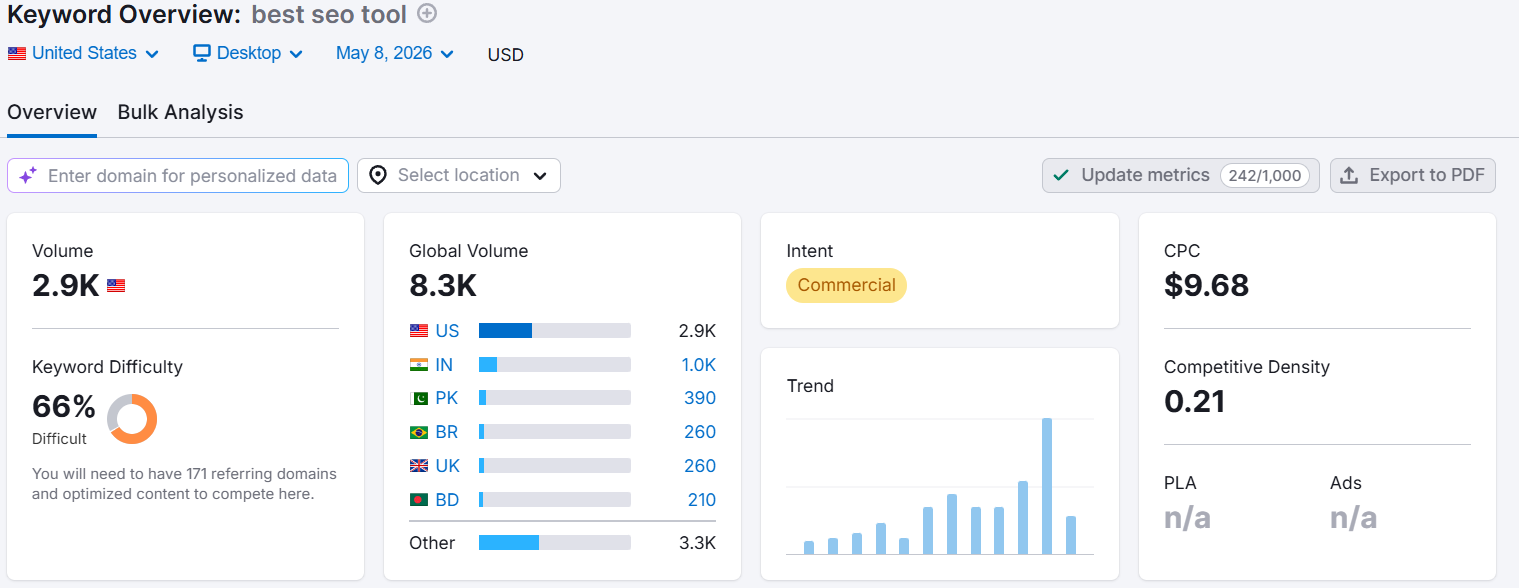
Semrush leads here for most workflows. The Keyword Magic Tool is excellent for finding long-tail variations, and its volume estimates track closest to Google Search Console actuals. Intent labels (informational, commercial, transactional) appear right in the interface, useful when you're building a content strategy, not just chasing random keywords.
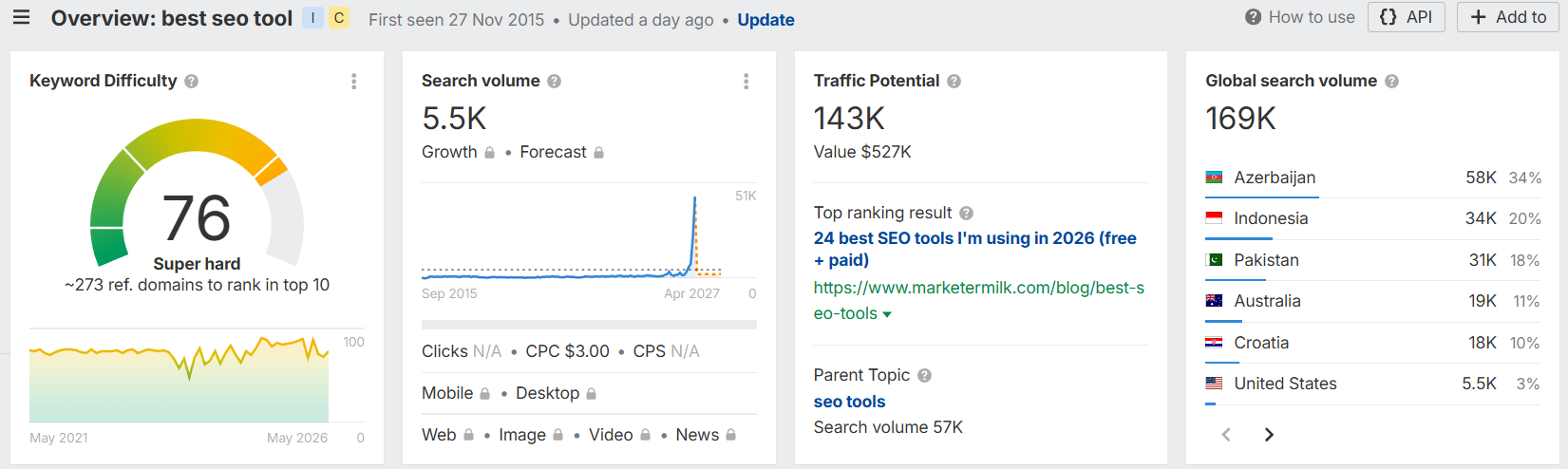
Ahrefs runs a 29-billion keyword database across 170+ countries. Its keyword difficulty score is the most trusted in the industry; it factors in the actual backlink profiles of pages currently ranking, not just aggregate stats. The "Traffic Potential" metric is uniquely actionable.
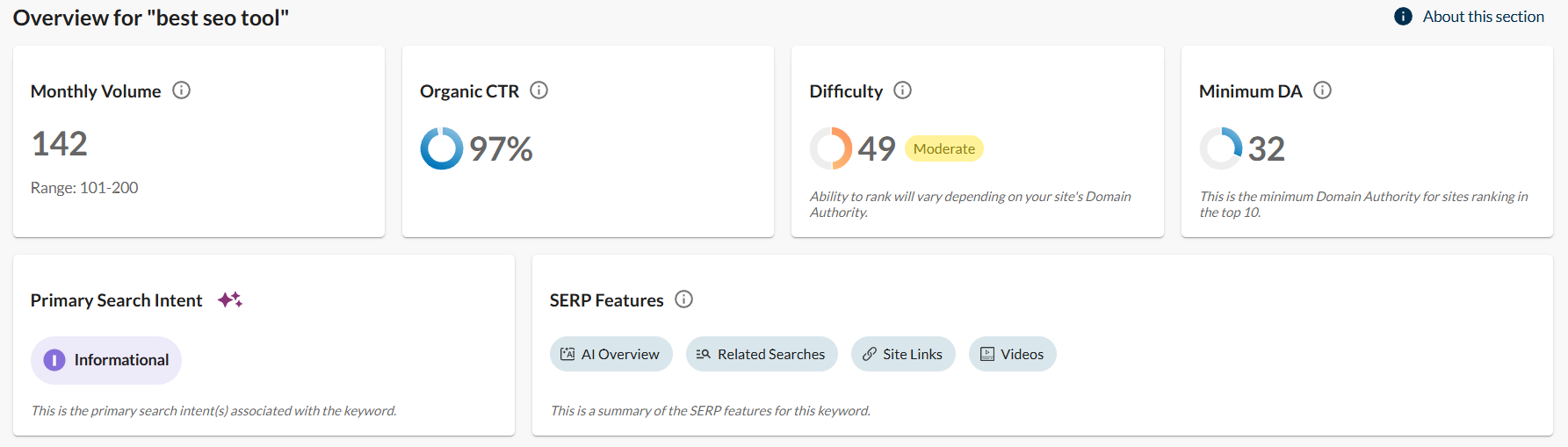
Moz has the smallest database at 1.25 billion keywords, behind both competitors. What it does well: the Priority Score blends volume, difficulty, and CTR into a single number. If you're not deep into SEO, it removes the guesswork and simplifies decisions.
We ran namobot.com through all three tools to compare backlink data directly, focusing on index size, freshness, and real-world usability.
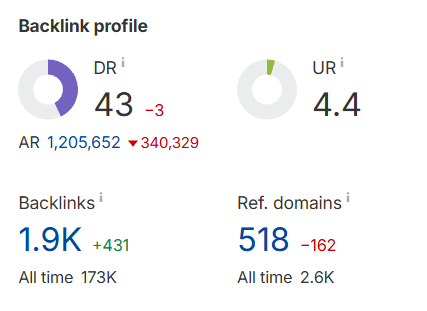
Ahrefs returned the most comprehensive and current results. New links to namobot.com appeared within 24–48 hours of going live. Ahrefs crawls ~8 billion pages per day and often indexes new links days or weeks ahead of competitors. Domain Rating (DR) is widely used in SEO outreach.
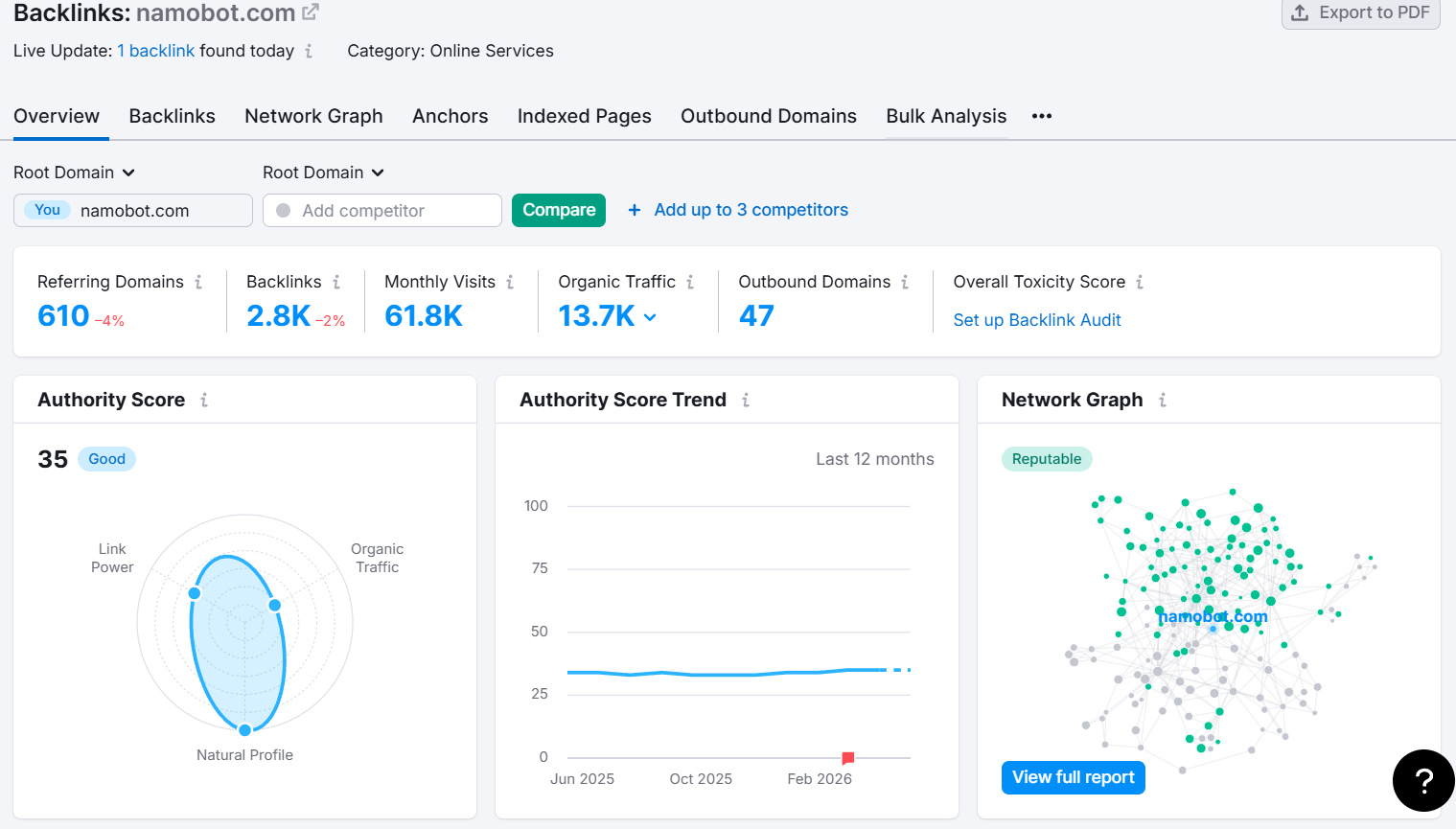
Semrush was close in coverage. Authority Score helps identify toxic links, making it especially useful for disavow workflows and audits. The index (~43T links) is large, but slightly slower than Ahrefs for newly discovered backlinks.
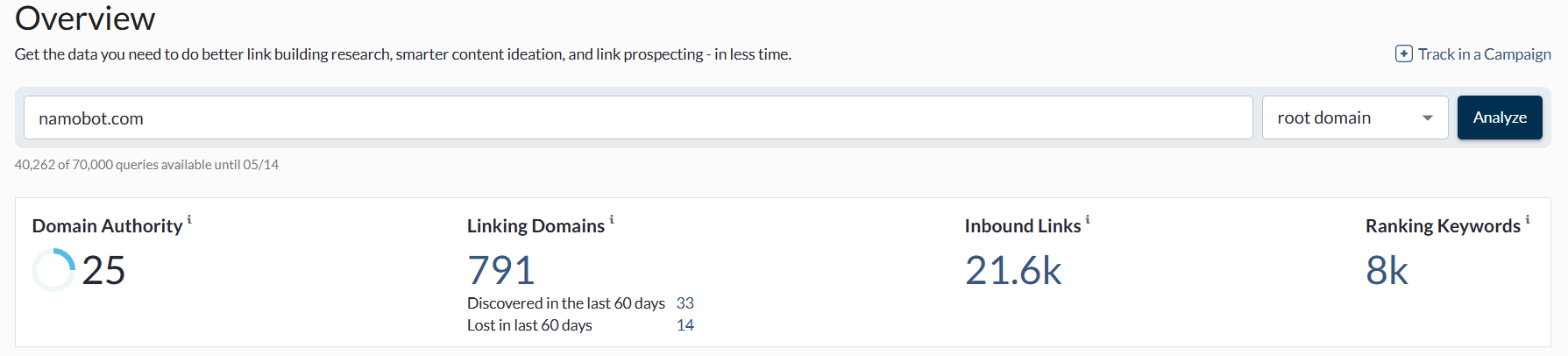
Moz is weakest for backlink discovery. Its Domain Authority (DA) is still widely recognized in client reporting and outreach. However, its index is smaller and updates less frequently, making it less ideal for competitive link research.
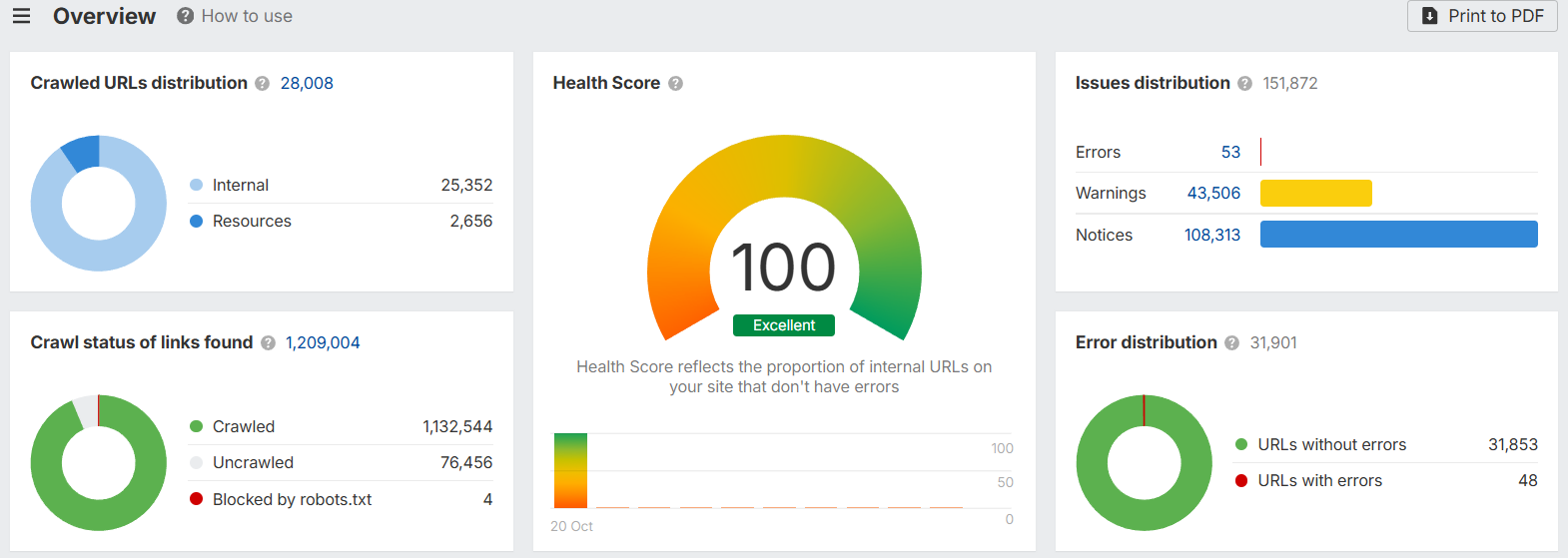
Semrush checks 140+ technical SEO issues — the deepest of the three. On namobot.com, it flagged Core Web Vitals problems, structured data gaps, and crawl depth issues that other tools only partially detected.
The trade-off: the interface requires some SEO knowledge to interpret correctly.
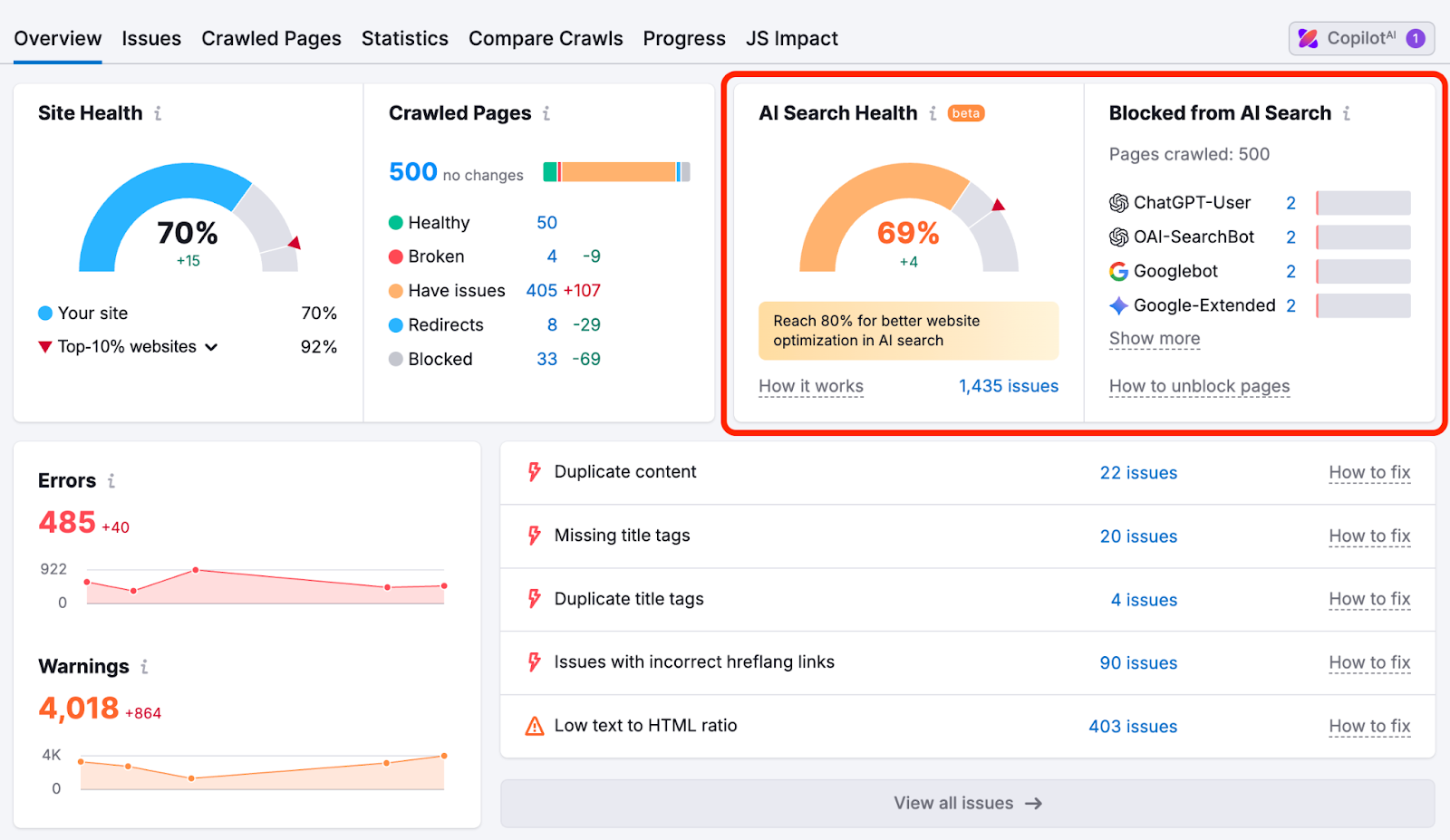
Ahrefs is fast and well-organized. Visualizations are cleaner than Semrush, and Core Web Vitals coverage is solid for most use cases.
Crawl credits are capped on lower-tier plans, which can limit large site audits.
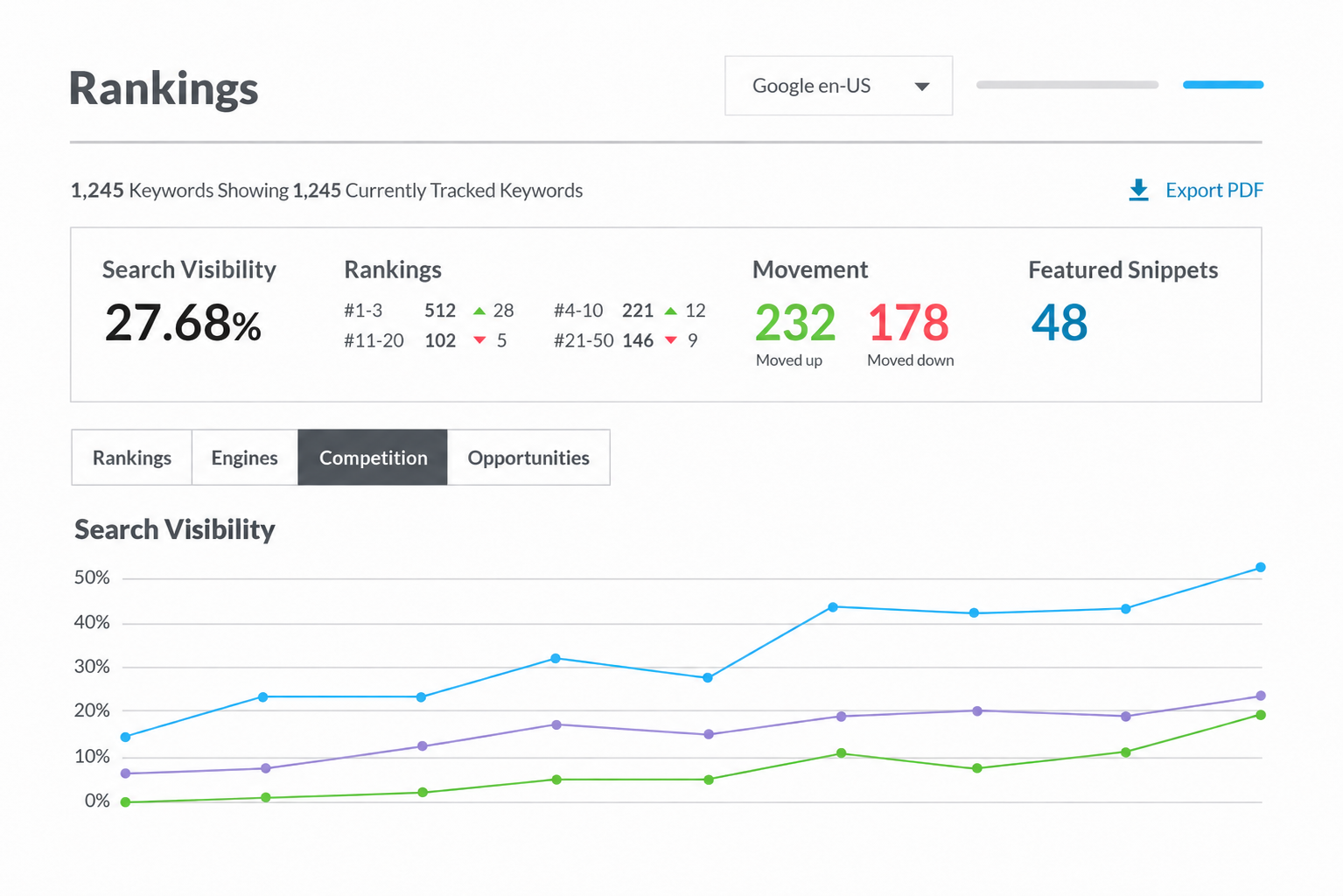
Moz prioritizes issues by impact instead of overwhelming lists. You see the top five problems that actually matter first. For small business sites, this approach is ideal.
It won’t catch everything Semrush does, but covers the essentials well.
Each SEO tool tracks different search engines and SERP features.
Tracks Google, Bing, and Yahoo. Clean and simple rank tracking system.
Tracks only Google but provides deep historical ranking data and share-of-voice insights.
Tracks Google, Bing, Baidu, and ChatGPT Search (beta). Most advanced SERP feature tracking system.
Semrush Position Tracking is the most feature-rich, as it monitors featured snippets, local pack positions, SERP features, and supports multiple devices and locations per project. If you're running multi-location campaigns or need to show clients SERP feature progress, nothing else comes close.
Ahrefs Rank Tracker has excellent historical data and shows the share of voice across your tracked keyword set. Good for spotting long-term trends. Expensive if you're tracking large keyword sets at scale.
Moz Rank Tracker is clean and reliable. Its real differentiator is Moz Local. If local pack rankings matter to you, Moz handles Google Business Profile integration and local pack monitoring better than either competitor.
This is one of the biggest differences between Moz, Ahrefs, and Semrush — and most SEO comparisons seriously underplay it.
Modern SEO is no longer just backlinks and rankings. Content production, optimization, AI workflows, and topical authority now play a central role in organic growth.
Semrush has the most comprehensive content toolkit of the three. ContentShake AI generates topic ideas and draft content, while SEO Writing Assistant grades drafts in real time against top-ranking pages.
Content Template creates optimized briefs before writing starts. If content production is part of your workflow, Semrush is the only platform here that truly supports it end-to-end.
Ahrefs offers Content Explorer, a searchable database of over a billion pages, filterable by traffic, backlinks, and social shares.
The AI Content Editor helps optimize drafts, but Ahrefs is stronger in ideation and research than full content production workflows.
Moz has no standalone content marketing toolkit. You only get basic on-page suggestions within site audits.
If content planning, AI workflows, or editorial optimization are important to your SEO strategy, this is a major gap compared to Semrush and Ahrefs.
Local SEO is one area where the differences between these tools become extremely obvious.
Moz Local syncs directly with Google Business Profile, manages citations across 15+ directories, tracks local pack rankings, and monitors review sentiment — all under one roof.
Unlike competitors, Moz Local is purpose-built specifically for local SEO rather than added later as an extra feature.
Semrush offers Listing Management powered by Yext, but it requires an additional paid add-on beyond the main subscription.
It works well for agencies managing many locations, though costs increase quickly for smaller businesses.
Ahrefs does not offer a dedicated local SEO platform or local listing management system.
It remains useful for backlink research on local projects, but that's where its local SEO functionality stops.
Moz Local is purpose-built for local SEO and clearly ahead of both Ahrefs and Semrush for citation management, review monitoring, and local pack tracking.
This is the category most older SEO comparisons completely miss — and increasingly what modern SEO teams care about most.
Google AI Overviews, ChatGPT Search, and Perplexity are changing how users discover brands online. Traditional keyword rankings are no longer the full picture.
Semrush has moved furthest into AI visibility tracking. The AI SEO Toolkit monitors brand visibility across ChatGPT, Google AI Overviews, and Perplexity.
You can now add ChatGPT as a search engine inside Position Tracking and monitor how often your brand appears inside AI-generated answers.
If Answer Engine Optimization (AEO) is part of your strategy, Semrush is currently the only platform with daily AI visibility monitoring built in.
Ahrefs scans large language model outputs for brand mentions and compares share of voice against competitors.
Its tracking cadence is broader and less real-time than Semrush, but the underlying data model is improving quickly.
Moz has a dedicated AI Visibility Dashboard. The tool lets you measure your brand's presence in AI-generated answers, benchmark competitors to see where they're getting discovered versus you, and identify the winning topics where AI is already surfacing your brand.
Beyond monitoring, the toolkit helps you uncover conversational prompts your audience uses with AI tools, build AI-driven content briefs, and track your AI search visibility in one place, integrated alongside the SEO metrics Moz is already known for.
Semrush is currently the only SEO platform with daily AI search visibility tracking built directly into its ecosystem.
Powerful features matter — but usability matters just as much. A complicated platform slows teams down and increases the learning curve.
Moz is the easiest SEO platform to use. The interface doesn't assume advanced SEO knowledge, making it ideal for beginners and small teams.
Priority Scores, impact-ranked issue lists, and simplified navigation allow users to become productive immediately without spending hours watching tutorials.
Ahrefs remains well-organized despite the depth of its SEO data and analysis tools.
The 2024 redesign improved navigation significantly, making intermediate users comfortable quickly without overwhelming the interface.
Semrush combines more than 50 tools inside one platform. That's both its biggest strength and biggest weakness.
Navigation feels overwhelming until users understand where everything lives. Best suited for experienced SEOs or larger teams using specialized workflows.
Moz is the easiest platform for anyone new to SEO software, with the smoothest onboarding and lowest learning curve.
Comparing how Moz, Ahrefs, and Semrush handle paid search, competitor ads, and advertising intelligence.
Focuses exclusively on organic search and does not offer tools for paid search or PPC data.
Provides essential paid search insights, allowing users to view competitor PPC keywords, see previews of active ad copy, and track paid landing pages.
Offers a specialized, high-level Advertising Toolkit that includes Product Listing Ads (PLA/Shopping) research, historical ad data, and cross-channel tracking via AdClarity.
Unlike its competitors, Semrush tracks advertising data across Display, Video, and Social Media platforms (such as Meta and YouTube).
Semrush provides detailed CPC (Cost-Per-Click) trends and regional ad data, making it a more robust choice for users managing complex paid campaigns.
the only platform offering a fully integrated, multi-channel advertising and PPC research suite.
Reporting quality matters heavily for agencies, freelancers, and teams delivering SEO performance updates to clients.
Semrush wins for agencies.
The My Reports drag-and-drop builder is flexible, white-label PDFs are available on Agency plans, and native Google Looker Studio integration means data goes directly into dashboards without manual CSV exports.
Moz reporting is clean and exportable.
Custom reports on Medium and Large plans. White-label on enterprise plans less flexible than Semrush overall.
Ahrefs has the weakest reporting.
No white-label option, no Looker Studio integration, and PDF exports are basic.
If you deliver regular client reports, this is a real gap.
white-label, Looker Studio, drag-and-drop builder.
Detailed pricing comparison for Moz, Ahrefs, and Semrush including plan limits, keyword tracking, crawl allowances, and upgrade requirements.
| Plan | Price/mo | Users | Campaigns | Keywords Tracked | Pages Crawled/mo | Reports/mo | Key Limitation |
|---|---|---|---|---|---|---|---|
| Starter | $49 | 1 | 1 | 50 | 20,000 | 50 | No on-demand crawl |
| Standard | $99 | 1 | 3 | 300 | 400,000 | 150 | 1 user seat only |
| Medium | $179 | 2 | 10 | 1,500 | 2,000,000 | 300 | Limited branded reports |
| Large | $299 | 3 | 25 | 3,000 | 5,000,000 | Unlimited | White-label on custom plans only |
✅ 30-day free trial on all plans. No credit card required. Annual billing saves ~20%.
The Standard plan at $99/mo is the sweet spot for most freelancers and small businesses — 300 tracked keywords covers the majority of solo SEO workflows.
Start Free Trial| Plan | Price/mo | Users | Projects | Keywords Tracked | Crawl Credits/mo | Historical Data | API Access | Key Limitation |
|---|---|---|---|---|---|---|---|---|
| Starter | $29 | 1 | 1 | 50 | 100 credits | 6 months | ❌ | Very limited — best for testing only |
| Lite | $129 | 1 | 5 | 750 | 1,000 credits | 6 months | ❌ | No historical data beyond 6mo, no API |
| Standard | $249 | 1 | 20 | 2,000 | Unlimited | 2 years | ❌ | 1 user seat, no API |
| Advanced | $449 | 1 | 50 | 5,000 | Unlimited | 5 years | ✅ | No white-label reporting |
| Enterprise | $1,499 | Custom | Unlimited | Custom | Unlimited | Unlimited | ✅ | Custom contract required |
| Plan | Price/mo | Users | Projects | Keywords Tracked | Results/Report | Historical Data | API Access | Key Limitation |
|---|---|---|---|---|---|---|---|---|
| Pro | $139.95 | 1 | 5 | 500 | 10,000 | 1 year | ❌ | No content tools, no historical beyond 1yr |
| Guru | $249.95 | 1 | 15 | 1,500 | 30,000 | Full | ❌ | 1 user seat, no white-label |
| Business | $499.95 | 3 | 40 | 5,000 | 50,000 | Full | ✅ | White-label on the Agency add-on only |
| Enterprise | Custom | Custom | Custom | Custom | Custom | Full | ✅ | Custom contract required |
Comparing the most realistic entry-level plans people actually buy in 2026. This is where pricing, crawl limits, keyword tracking, and feature access start to matter.
| Features |
Moz Standard$99 |
Ahrefs Lite$129 |
Semrush Pro$139.95 |
|---|---|---|---|
| Keywords tracked | 300 | 750 | 500 |
| Projects/campaigns | 3 | 5 | 5 |
| Users included | 1 | 1 | 1 |
| Crawl volume | 400K pages/mo | 1,000 credits/mo | 100K pages/audit |
| Historical data | Full | 6 months only | 1 year only |
| API access | ✅ | ❌ | ❌ |
| Content tools | ❌ | ❌ | ❌ |
| Local SEO | Add-on available | ❌ | Extra cost |
| Free trial | 30 days | ❌ None | 7 days |
Moz Pro — lowest entry price and the only tool with a meaningful free trial at this tier.
Semrush — breadth of features justifies the cost when you're using the full platform.
Ahrefs — backlink data quality is unmatched even at the Lite tier.
Review sentiment from G2, Capterra, and SEO communities highlights where each tool actually performs best in real-world workflows.
There's no universal best SEO tool. Only the best tool for your specific situation.
If you're already using Ahrefs or evaluating alternatives, here's a clear breakdown of what changes when you switch to Moz.
Bottom line: If link building is your primary use case, stay on Ahrefs. If you're doing content-focused or local SEO and want to cut costs, Moz is worth trialing.
A practical breakdown of what changes if you're switching from Semrush to Moz in real SEO workflows.
Bottom line: If you're on Semrush and use most of what it offers, the switch isn't worth it. If you're a solo SEO using Semrush mainly for keyword research and rank tracking, Moz covers 80% of those needs at 70% of the price.
After running all three tools against the same real websites, including namobot.com, and reviewing thousands of user opinions across G2, Reddit, and Capterra, here's the conclusion:
Moz Pro is the best starting point for most people. Most affordable, easiest to use, and the 30-day trial is the only risk-free way to get full access to a serious SEO tool. Best for beginners, local SEO, and budget-conscious teams.
→ Try Moz FreeAhrefs is the backlink research gold standard. If link building or Content Explorer workflows are core to what you do, the premium is justified. Just know you're paying $129 before you see anything.
→ See Ahrefs PlansSemrush is the most powerful tool in this comparison, built for teams that will actually use the full feature set. Agencies, multi-channel marketers, and enterprise teams get real value from the breadth.
→ Try Semrush FreeOur Top Pick: Moz Pro — 30-day free trial · $49/mo to start · No credit card required → Start Your Free Trial